
The Dadasaheb Phalke Award is India’s highest cinema honor presented for lifetime achievement, featuring Devika Rani as the first winner in 1969, and carrying a Swarna Kamal trophy, a Rs 15,00,000 cash prize, and a ceremonial shawl.
This definitive guide covers every single recipient of the Dadasaheb Phalke Award from 1969 to 2026. It explores the history of the award, the meticulous selection process, landmark records, posthumous awards, and unique family dynasties that have shaped Indian cinema.
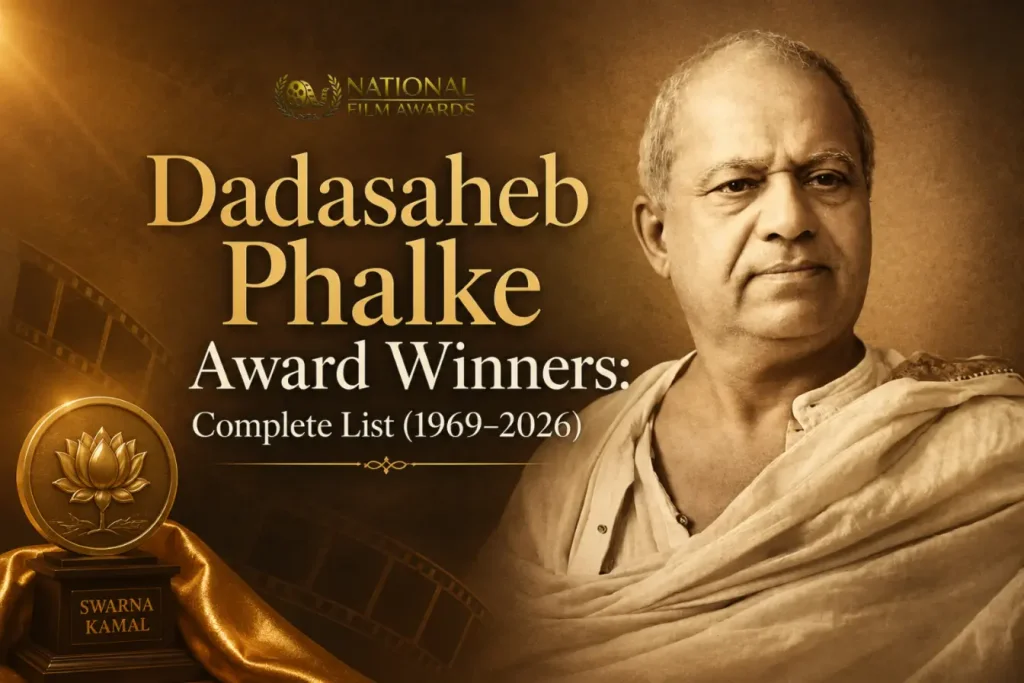
Table of Contents
- What Is the Dadasaheb Phalke Award?
- Dadasaheb Phalke Award Winners: Complete List (1969 to 2026)
- How Is the Dadasaheb Phalke Award Selected?
- Records and Historical Firsts
- Posthumous Dadasaheb Phalke Awards
- Family Pairs Who Both Received the Dadasaheb Phalke Award
- Dadasaheb Phalke Winners by Profession
- Recent Dadasaheb Phalke Award Winners (2015 to 2023)
- Frequently Asked Questions About the Dadasaheb Phalke Award
What Is the Dadasaheb Phalke Award?
The Dadasaheb Phalke Award is India’s most prestigious lifetime achievement honor named after the Father of Indian Cinema, instituted by the Government of India in 1969 to recognize extraordinary contributions to the film industry.
Dhundiraj Govind Phalke directed Raja Harishchandra in 1913. Historians universally recognize this work as India’s first full-length feature film. The nation respectfully calls him the Father of Indian Cinema. The Government of India chose to name the country’s highest cinematic honor after him to preserve his legacy.
The award differs significantly from regular National Film Award categories. A regular category like Best Actor honors a single performance in a specific film from a specific calendar year. The Dadasaheb Phalke Award honors a complete lifetime of work. It recognizes an individual whose entire career has elevated Indian culture and cinematic art.
The honor carries three distinct components. The winner receives a Swarna Kamal (Golden Lotus) medallion. The winner receives a cash prize of Rs 15,00,000. Finally, the President of India drapes a ceremonial shawl over the winner’s shoulders at the National Film Awards ceremony.
Explore the Swarna Kamal and Rajat Kamal explained guide to understand the physical trophies of the National Film Awards.
Dadasaheb Phalke Award Winners: Complete List (1969 to 2026)
The Government of India has awarded the Dadasaheb Phalke Award to 55 extraordinary recipients from Devika Rani in 1969 to Mohanlal for the year 2023, representing the absolute pinnacle of Indian cinematic achievement.
The following database provides the complete, historically verified list of all 55 recipients. The year indicates the award year, which is typically presented at the ceremony held in the subsequent calendar year.
| Year | Recipient | Profession |
|---|---|---|
| 1969 | Devika Rani | Actress |
| 1970 | Birendranath Sircar | Producer |
| 1971 | Prithviraj Kapoor (Posthumous) | Actor |
| 1972 | Pankaj Mullick | Music Composer |
| 1973 | Sulochana (Ruby Myers) | Actress |
| 1974 | B.N. Reddy | Director |
| 1975 | Dhiren Ganguly | Actor / Director |
| 1976 | Kanan Devi | Actress / Singer |
| 1977 | Nitin Bose | Director / Cinematographer |
| 1978 | Raichand Boral | Music Composer / Director |
| 1979 | Sohrab Modi | Actor / Director |
| 1980 | P. Jairaj | Actor / Director |
| 1981 | Naushad | Music Composer |
| 1982 | L.V. Prasad | Actor / Director |
| 1983 | Durga Khote | Actress |
| 1984 | Satyajit Ray | Director |
| 1985 | V. Shantaram | Actor / Director |
| 1986 | B. Nagi Reddy | Producer |
| 1987 | Raj Kapoor | Actor / Director |
| 1988 | Ashok Kumar | Actor |
| 1989 | Lata Mangeshkar | Playback Singer |
| 1990 | A. Nageswara Rao | Actor |
| 1991 | B.N. Sircar (Posthumous) | Director |
| 1992 | Bhupen Hazarika | Playback Singer |
| 1993 | Majrooh Sultanpuri | Lyricist |
| 1994 | Dilip Kumar | Actor |
| 1995 | Rajkumar | Actor |
| 1996 | Sivaji Ganesan | Actor |
| 1997 | Kavi Pradeep | Lyricist |
| 1998 | B.R. Chopra | Director / Producer |
| 1999 | Hrishikesh Mukherjee | Director |
| 2000 | Asha Bhosle | Playback Singer |
| 2001 | Yash Chopra | Director |
| 2002 | Dev Anand | Actor |
| 2003 | Mrinal Sen | Director |
| 2004 | Adoor Gopalakrishnan | Director |
| 2005 | Shyam Benegal | Director |
| 2006 | Tapan Sinha | Director |
| 2007 | Manna Dey | Playback Singer |
| 2008 | V.K. Murthy | Cinematographer |
| 2009 | D. Ramanaidu | Producer |
| 2010 | K. Balachander | Director |
| 2011 | Soumitra Chatterjee | Actor |
| 2012 | Pran | Actor |
| 2013 | Gulzar | Lyricist / Director |
| 2014 | Shashi Kapoor | Actor / Producer |
| 2015 | Manoj Kumar | Actor / Director |
| 2016 | K. Viswanath | Director |
| 2017 | Vinod Khanna (Posthumous) | Actor |
| 2018 | Amitabh Bachchan | Actor |
| 2019 | Rajinikanth | Actor |
| 2020 | Asha Parekh | Actress |
| 2021 | Waheeda Rehman | Actress |
| 2022 | Mithun Chakraborty | Actor |
| 2023 | Mohanlal | Actor |
Review the all National Film Award winners from 1954 master index to see the regular category winners alongside the Phalke recipients.
How Is the Dadasaheb Phalke Award Selected?
A dedicated Selection Committee of eminent film personalities appointed by the Ministry of Information and Broadcasting evaluates nominations from film bodies and previous awardees to select the final Dadasaheb Phalke winner.
The selection process for India’s highest cinema honor differs from the regular National Film Awards process. The National Film Development Corporation (NFDC) sets up regional panels and a central jury to evaluate feature films. The Dadasaheb Phalke Award uses a completely separate specialized committee.
The Ministry of Information and Broadcasting invites nominations from credible sources. These sources include recognized film industry associations, established trade bodies, and living individuals who have previously won the Dadasaheb Phalke Award. This ensures that the nominations come from deep within the film community.
The Ministry then appoints a high-level Selection Committee. This committee usually comprises five to seven highly respected veterans of Indian cinema. These members evaluate the nominations based on the candidate’s entire lifetime body of work. They look for massive cultural impact, sustained excellence over decades, and a profound contribution to the growth of Indian cinema.
The Selection Committee deliberates and makes a single, unanimous recommendation to the Government of India. The Ministry then formally announces the winner. The rigorous, peer-reviewed nature of this selection process maintains the absolute prestige of the honor.
Read the National Film Awards jury selection process to understand how regular feature films are evaluated.
Records and Historical Firsts
The first recipient was Devika Rani in 1969, while Mohanlal became the youngest recipient at age 65, Manna Dey the oldest at 90, and Prithviraj Kapoor the first posthumous winner.
The 55-year history of the award contains several fascinating records and milestones that highlight the diversity of Indian cinema.
First-Ever Recipients and Milestones
Devika Rani holds multiple historical records. She became the first-ever recipient of the award in 1969. This automatically made her the first woman to receive the honor. The industry calls her the First Lady of Indian Cinema for her pioneering work in the 1930s.
Satyajit Ray won the award in 1984. He stands as the only internationally acclaimed parallel cinema auteur to receive the honor before winning an Academy Award. Amitabh Bachchan won the award in 2018. He represents the most commercially dominant mainstream actor to ever receive the prize. Rajinikanth won in 2019, cementing his status as the biggest superstar of South Indian cinema.
Youngest and Oldest Recipients
The award requires a lifetime of contribution. Therefore, recipients are almost always senior citizens.
Mohanlal became the youngest recipient in the history of the award. The government announced him as the winner for the year 2023. He received the honor in 2025 at the age of 65. His selection recognized his extraordinary dominance and versatility in Malayalam cinema over four decades.
Singer Manna Dey holds the record as the oldest recipient. He received the award for the year 2007 when he was 90 years old. His selection honored a magnificent playback singing career that spanned the golden era of Hindi cinema.
Explore the Best Actor National Award all-time winners to see which Phalke recipients also dominated the competitive categories.
Posthumous Dadasaheb Phalke Awards
The Government of India has awarded the Dadasaheb Phalke Award posthumously only twice in 55 years, honoring Prithviraj Kapoor in 1971 and Vinod Khanna in 2017 after they passed away.
The regulations do not explicitly forbid posthumous awards. However, the Selection Committee has historically preferred to honor living legends so they can physically receive the nation’s respect at Vigyan Bhawan.
The two exceptions occurred under specific circumstances. Prithviraj Kapoor received the honor for the year 1971. He was the patriarch of the famous Kapoor family and a pioneer of Indian theatre and cinema. He passed away shortly before the ceremony could take place. His son Raj Kapoor accepted the award on his behalf.
Vinod Khanna received the honor for the year 2017. The veteran actor passed away in April 2017. The Selection Committee chose to honor his massive contribution to Hindi cinema in the 1970s and 1980s. His son Akshaye Khanna accepted the Swarna Kamal from the President.
These rare posthumous awards highlight instances where the jury felt the individual’s legacy was too monumental to leave unrecognized, despite their recent passing.
Read the National Film Awards history for more context on the evolution of award policies.
Family Pairs Who Both Received the Dadasaheb Phalke Award
The history of the Dadasaheb Phalke Award features four extraordinary family pairs where two immediate relatives both received the honor, including the Lata-Asha sisters and the Raj-Shashi Kapoor brothers.
Indian cinema has a long tradition of artistic families. The Dadasaheb Phalke Award database proves this beautifully. Four separate pairs of siblings have achieved the highest level of national recognition independently.
| Family Pair | Relationship | Years Won |
|---|---|---|
| Lata Mangeshkar & Asha Bhosle | Sisters | 1989 and 2000 |
| Raj Kapoor & Shashi Kapoor | Brothers | 1987 and 2014 |
| B.N. Reddy & B. Nagi Reddy | Brothers | 1974 and 1986 |
| B.R. Chopra & Yash Chopra | Brothers | 1998 and 2001 |
Lata Mangeshkar and Asha Bhosle remain the only female sibling pair to achieve this feat. Their combined dominance over Indian playback singing lasted more than six decades. The Kapoor brothers, Raj and Shashi, both built massive acting careers and successful production houses.
The Reddy brothers, B.N. Reddy and B. Nagi Reddy, were pioneers of South Indian cinema production. The Chopra brothers, B.R. Chopra and Yash Chopra, defined the aesthetics of mainstream Bollywood across different eras. These pairs prove that profound cinematic talent can indeed run in families.
Browse the Best Actress National Award complete history to see other remarkable achievements by women in cinema.
Dadasaheb Phalke Winners by Profession
An analysis of the Dadasaheb Phalke winners shows that actors and actresses form the largest group, followed closely by film directors and legendary playback singers who shaped Indian music.
The award is open to any profession within the film industry. The historical data shows a wide distribution of talent. While on-screen performers naturally capture public attention, the Selection Committee has consistently honored the artists behind the camera as well.
| Profession | Number of Recipients | Notable Names |
|---|---|---|
| Actors and Actresses | 22 | Amitabh Bachchan, Rajinikanth, Waheeda Rehman, Devika Rani |
| Directors | 18 | Satyajit Ray, Yash Chopra, Shyam Benegal, Adoor Gopalakrishnan |
| Playback Singers / Musicians | 8 | Lata Mangeshkar, Asha Bhosle, Naushad, Bhupen Hazarika |
| Producers | 5 | D. Ramanaidu, B. Nagi Reddy |
| Technicians / Others | 2 | V.K. Murthy (Cinematographer), Majrooh Sultanpuri (Lyricist) |
V.K. Murthy remains the only cinematographer to win the award. His mastery of black-and-white lighting defined the visual style of Guru Dutt’s classic films. The strong representation of singers and composers reflects how crucial music is to the identity of Indian cinema.
Read the Best Director National Award winners database for a deeper look at directorial achievements.
Recent Dadasaheb Phalke Award Winners (2015 to 2023)
The recent Dadasaheb Phalke Award winners from Manoj Kumar in 2015 through Mohanlal in 2023 represent a deliberate effort by the committee to recognize diverse regional and commercial cinema titans.
The last decade of awards has seen the honor presented to some of the most recognizable faces in the country.
Manoj Kumar (2015): The committee honored the veteran actor and director known as “Bharat Kumar” for his patriotic films like Upkar and Purab Aur Paschim.
K. Viswanath (2016): The legendary Telugu director received the award for his socially conscious films that masterfully integrated Indian classical art forms into mainstream cinema.
Vinod Khanna (2017): The committee honored the late actor for his intense screen presence and massive popularity during the 1970s and 1980s.
Amitabh Bachchan (2018): The “Star of the Millennium” received the honor for his unparalleled dominance of Hindi cinema, defining the “Angry Young Man” archetype.
Rajinikanth (2019): The Tamil superstar received the award for his unique style, massive cultural impact, and ability to unite audiences across the world.
Asha Parekh (2020): The beloved “Hit Girl” of the 1960s received the honor for her long string of successful films and her later work in television administration.
Waheeda Rehman (2021): The committee recognized the graceful actress for her deeply moving performances in classics like Guide and Pyaasa.
Mithun Chakraborty (2022): The versatile actor received the award for his journey from parallel cinema brilliance in Mrigayaa to massive commercial stardom.
Mohanlal (2023): The extraordinary Malayalam actor received the honor as the youngest recipient, recognized for his natural acting style and complete mastery of the craft.
Review the 71st National Film Awards complete winners and the 70th National Film Awards complete winners lists for recent contexts.
Frequently Asked Questions About the Dadasaheb Phalke Award
Who has won the most Dadasaheb Phalke Awards?
No individual can win the Dadasaheb Phalke Award more than once. The Government of India presents this honor strictly as a lifetime achievement award. Once an individual receives the award for their complete body of work, they cannot be nominated again.
Has any actor won the Dadasaheb Phalke Award more than once?
No actor has won the Dadasaheb Phalke Award more than once. The award recognizes a complete lifetime of contribution to Indian cinema. The Selection Committee strictly adheres to the rule of presenting the honor to an individual only a single time.
Who was the first woman to receive the Dadasaheb Phalke Award?
Devika Rani was the first woman to receive the Dadasaheb Phalke Award. The Government of India honored her in 1969. She was not only the first woman but the very first recipient overall, recognizing her status as the First Lady of Indian Cinema.
What is the prize money for the Dadasaheb Phalke Award?
The prize money for the Dadasaheb Phalke Award is Rs 15,00,000. The recipient also receives a Swarna Kamal (Golden Lotus) physical trophy and a ceremonial shawl draped over their shoulders by the President of India during the National Film Awards ceremony.
Can a foreign national win the Dadasaheb Phalke Award?
No, a foreign national cannot win the Dadasaheb Phalke Award. The official regulations stipulate that the award is strictly for Indian nationals who have made an outstanding, lifelong contribution to the growth and development of Indian cinema.
Discover More National Film Awards Coverage
- Read the National Film Awards ceremony guide
- Explore the Best Feature Film National Award history
- Browse the National Film Awards categories guide
- Anticipate the 72nd National Film Awards
- Read the complete guide to National Film Awards